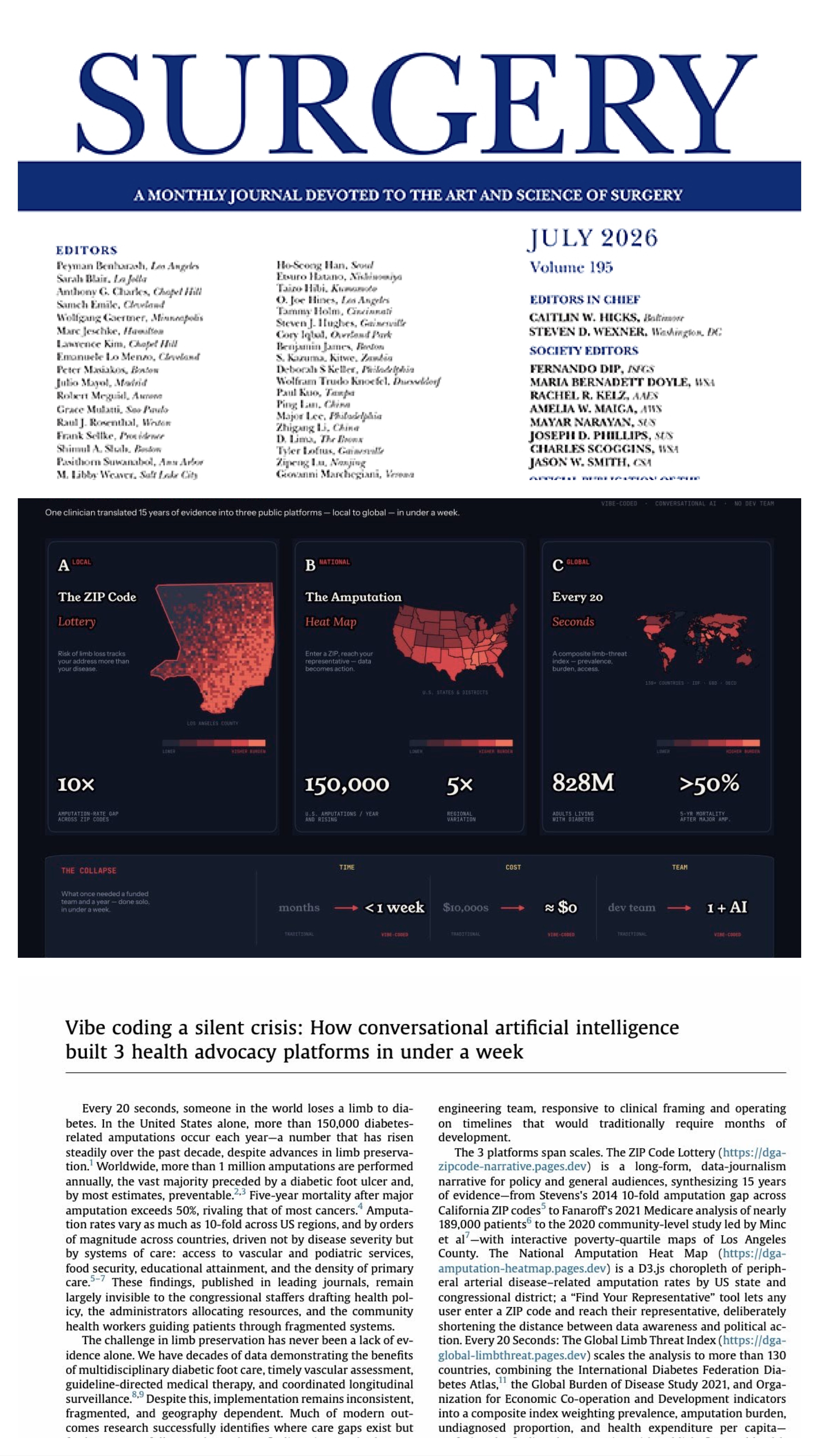
 Published in Surgery
Vibe coding a silent crisis
How conversational artificial intelligence built these three health-advocacy platforms in under a week.
Read the peer-reviewed article →
Published in Surgery
Vibe coding a silent crisis
How conversational artificial intelligence built these three health-advocacy platforms in under a week.
Read the peer-reviewed article →
Diabetes, limb loss, and a preventable crisis — mapped.
Lower-extremity amputation is one of the most devastating complications of diabetes and peripheral arterial disease — yet it remains one of the least tracked health outcomes globally. While diabetes surveillance has improved dramatically through the IDF Diabetes Atlas, amputation reporting remains fragmented, inconsistent, and in many countries, nonexistent.
What we do know is alarming. The incidence of all lower-extremity amputations ranges from 5.8 to 31 per 100,000 in the total population and from 46.1 to 9,600 per 100,000 in populations with diabetes — a staggering 200-fold variation that tracks not with disease biology, but with systems of care.
This map synthesizes data from the IDF Diabetes Atlas (11th edition, 2024), the Global Burden of Disease Study 2021, published country-level amputation studies, and OECD health indicators to construct a composite picture of where limbs are most at risk — and why.
Select a data layer to explore. Hover over any country for details. The Composite Index combines diabetes prevalence, known amputation burden, proportion of undiagnosed cases, and healthcare expenditure per capita to estimate overall limb threat.
Age-standardized prevalence shows dramatic regional variation. The Middle East & North Africa region carries the highest burden — driven by rapid urbanization, dietary shifts, and genetic predisposition — while sub-Saharan Africa reports the lowest rates, likely underestimated due to limited surveillance.
Diabetes prevalence alone does not predict amputation rates. Japan and South Korea have among the lowest amputation rates globally despite significant diabetes burdens — because organized systems of specialist foot care, early detection, and revascularization infrastructure intervene before ulcers progress to limb loss.
Conversely, nations with high diabetes prevalence and fragmented vascular care — many in South Asia, the Middle East, and sub-Saharan Africa — face a compounding crisis. The 43% of cases that remain undiagnosed are also the 43% most likely to present late, with advanced tissue loss.
The OECD data reveals a critical finding: countries with publicly-financed health systems show lower amputation rates than insurance-based systems, even after adjusting for diabetes prevalence — a difference of approximately 4.5 amputations per 100,000.
Australia presents a paradox: despite a universal healthcare system, it recorded the highest and continuously rising LEA incidence among EU15+ nations from 1990 to 2017, driven in part by its Indigenous population's disproportionate disease burden and geographic access challenges.
Age-standardized diabetes prevalence (%) for adults 20–79 from the IDF Diabetes Atlas 11th edition (2024), covering 215 countries and territories.
LEA incidence rates from GBD 2021 (204 countries), supplemented by OECD, VASCUNET, and country-specific published studies (Moxey 2011, Hughes 2020).
Percentage of diabetes cases undiagnosed, from IDF 2024. Reflects health system screening capacity — a proxy for late-presentation risk.
Weighted composite: diabetes prevalence (30%), amputation burden tier (30%), undiagnosed proportion (20%), inverse health expenditure (20%). Normalized 0–100.